SRI LANKA’S ISLAMIC HERITAGE AND ITS LINKS WITH EAST ASIA
The emergence and spread of Islam in Sri Lanka is very intimately interlinked with the Arab commercial activities in the Indian Ocean region which had been a seen of intense trading activities from antiquity. The Indian Ocean trade extended from Persian Gulf and Southern Arabia as far as Moluccas and Canton in the East moving westward covering Indonesian archipelago, the straits of Malacca, the parts of Bengal and Gujarat, the Coromandal and Malabar Coasts to Hormuz as the head of the Persian Gulf, Aden and East African trade settlements.
The central position of Sri Lanka between Africa, India and China made it an important center in this East-West trade and in this trade Arabs from very early times played an important and significant role.
The Arab contact with Sri Lanka dates back to pre-Christian times. The writings of the Greeks and Romans indicate the presence of the Arabs in the Island in the first century of the Christian era. Mahavamsa one of the main sources of island’s early history mentions that a certain section was set apart for the Yonas in the capital city of Anuradhapura in the reign of Pandukabhaya (437-407 BC) and Yonas are identified as Arabs.1
With the advent of Islam and the subsequent expansion of the Muslim empire under the Caliphs the Arab commercial activity received fresh impetus, which resulted in the expansion of the maritime trade in the Indian Ocean region. Moreover Islam linked most of the people engaged in trade activity in the region such as Arabs, Persians and Abyssinians into one single fraternity and the Arab settlements, which had already emerged in the island’s ports, were Islamised.
The existence of Muslim settlements during the 8th century is confirmed by an incident narrated the Arab historian Al-Baladuri (D. 892 A.D) in his book Futuhul Buldan and according to him just prior to the conquest of Sind the king of the island of rubies (Jeziratul Yaqoot) had sent to Hajjaj ibn Yusuf (710 A.D), the powerful viceroy of the Umayyads in Iraq the daughters of some Muslim merchants who have died in the island, but this ship was attacked by some sea pirates at Daybal (near modern Karachi) and this incidence led to series of raids which ultimately resulted in the conquest of Sind by Mohamed ibn Qasim in 715 A.D.2
The ascendancy of the Abbasid’s during the 9th and 10th centuries and the patronage they extended to Arab commercial activities enable the Muslims to dominate the Indian Ocean trade. As foreign trade grew in importance, the Muslims appeared to have settled in large numbers in the coastal port cities of Sri Lanka from where they in course of time moved into the interior of the island. Muslims were able to carry on their trade activities in a peaceful atmosphere and practiced their religion mainly due to the conciliery attitude and the spirit of tolerance of the Sri Lankan rulers towards the Muslims and the religion of Islam. The links they maintained with the Islamic mainland helped them to maintained and preserve their religious and cultural identity.
Archaeological evidences confirm the existences of Muslim settlements in the coastal port cities during the 9th and 10th centuries. The most significant are the Arabic inscriptions discovered in Colombo, Puliyanteewu, Ellupitiya and Tirukkeswaram in the present Mannar district. Apart form the Colombo one the latter three inscriptions were discovered around Mantai, which was an important enter-port in the East West trade and occupied an important place as Siraf in the Persian Gulf. The Near Eastern pottery and ceramic discovered at Mantai confirm its link with Siraf. 3
During this period the Muslims had a very strong cultural link with Baghdad, the capital of the Abbasid Empire. This was confirmed by the discovery of an Arabic inscription in Colombo, which belongs to the 4th century A.H. This tomb inscription erected on the grave of Khalid bin Abu Bakaya whom the Caliph had send to Sri Lanka in response to the request of the Muslims for a religious teacher. It is stated he died in Sri Lanka in 317 A.H – 940 AD and the Caliph had sent a stone inscribed in ornamental Kufic to be placed on his grave. Thus we see that the commercial contacts between the Muslims of Sri Lanka and the Arab world gradually evolving into a cultural relationship. It is also interesting to observe that Khatib Al Baghdadi in his Tarikh al Baghdad refers to a scholar by the name Abdur Raheem bin Hatim Moosa as Seilani who was in Baghdad around 264 A.H – 877 AD. The Nisba As Seilani may be due to his long stay in Ceylon or Seilan as it was then known to the Arabs.4
Due to the close relationship Muslims had with the Abbasid Caliphate they were able to procure scientifical medical works that were compiled during the period of great intellectual resurgence. Alexander Johnston who was the chief justice of Ceylon during the British period has the following observation to make in this regard:
“One of the principle works of medicine they introduced into Ceylon was the works of Avicenna. They also introduced Arabic translations of Aristotle, Plato, Euclid, Galen and Ptolemy, extracts of which were brought to me when I was in Ceylon by the Mohammedan priests and merchants who stated that the work themselves had originally been procured from Baghdad by their ancestors and remain for hundred years with their families.” 5
It was during this period that increased references to Sri Lanka are found in Arabic Chronicles especially in the works of Arab seafarers who had visited Sri Lanka. Sulaiman Al Tajir visited Sri Lanka in 850 AD and his impressions are incorporated in Silsila Al Tawarikh of Abu Zaid Al Sirafi who visited Sri Lanka in 900 AD. Al Masoudi visited Sri Lanka around 930 A.D and gives a vivid description about the geography and customs and traditions of the people of Sri Lanka in his famous geographical compendium Muruj Al Dhahab. Though the Arab of geographers of this period such as Al-Isthakri (d. 950 AD), Ibn Hawkal (977 AD) and Al-Maqdisi (985 AD) did not visit Sri Lanka they had obtained valuable information about the island from other Arab travellers and sailors and incorporated in their works. Al-Qazwini (d.1283 A.D) has given an interesting account of the fauna and flora of Ceylon. He also speaks about a distinguished scholar from Sri Lanka Sheik Sadid-ud-Din As-Sarandibi who had visited Qazwin.6
It is pertinent at this juncture to speak about the different names assigned by the Arabs to Sri Lanka. Ibn-Khurdhabi (d.845 A.D) in his Kitab-al-Masalik Wal- Mamalik, refers to Sri Lanka as Serendib, corruption of Sanskrit Sinhala Dvipa. The name Serendib was sometimes used in a narrow sense to denote only the district in which Adam’s Peak was situated. Idrisi and Sulaiman Tajir called Sri Lanka as Serendib. Sri Lanka was also known to Arabs as Sailan or As-Sahilan. Al-Biruni refers to it as Sangal Dip, Swarnadip and also as Swarnabhoom. Ibn-Rusta (d.903 A.D), a Persian author of Kitab al- Alaq an-Nafisa calls it Taprabani.7
It is stated that almost all the great poets of Iran including Firdowsi (d.1020 A.D) the author of famous Persian classic Shah Nameh, with the only exception of Hafiz of Shiraz (d.1389 A.D) have refer to Serendib. It is interesting to notice, that Sri Lanka is also mentioned in the Arabian Tales of renown, known as The Thousand and One Nights . These Arabian Tales based on the experiences of navigators were probably composed in the early Abbaside period (750-850 A.D) and there is a reference in the seventh voyage of Sindbad of taking presence from the king of Sri Lanka to the Caliph of Baghdad and the Caliph reciprocating the Sri Lankan king’s gifts. It is recounted that Sindbad obtained from Sri Lanka diamonds, precious stones, sandalwood, camphor, cloves, cinnamon, pepper, coconut and ivories during his voyages. It is evident of the Arab knowledge of this country and of there familiarity with the produce of the land. These tales really supplements the records of Arab geographers, historians and mariners. These anecdotes based on information or in some cases of direct experience revealed that the Arabs evinced much interest in the local produce of the land which they carried to distant countries in the East and West and bears testimony to the close relations between Sri Lanka and Arabs.
During the 9th and 10 the centuries, the belief that Prophet Adam descended on a mountain known as Adam’s peak in Serendib had been widely prevalent in the Muslim world.8 It is difficult to state with historical certainty when this tradition came into existence. But this belief is set to have been current among the Coptic Christians in the 4th and 5th centuries A.D.9 According to Emerson Tennant the Muslim pilgrimage is stated to have begun abut the 10th century. Ibn Batuta in his Rihla states that it was a pious saint by the name Sheik Abdullah Al Khafif who first opened up the route to Adam’s peak. One of the earliest references to Jabal Adam or Adam’s peak is found in Al Tabari (9th century). Sulaiman Al Tajir of Siraf in the account of his voyages to India and China refers to Adam’s peak by the name Al-Rohul. Arab geographer Al-Idrisi who worked at the court Roger II of Sicily had given a description of the mountain. Ibn Batuta who visited Sri Lanka in 1344 describes in his travels the route he took to Adam’s peak.10 An Arabic inscription ascribed to 13th century was found in Bagawalane a cave about 100 feet below the summit of Adam’s peak. This inscription which is fragmentary bears the phrase “Muhammad may God bless him; the father of mankind (Abul Basher)”. It is also pertinent to mention here the Balangoda inscription in Farsi script bearing the words ‘Darwesh and Dunya’.
After the 10th century with the disintegration of the Abbasid empire the political unity of the Muslim world was broken and there came into being sundry dynasties both in the Eastern and Western parts of the Muslim world. Wit the decline of Baghdad as the Abbasid Egypt and Persia came into prominent as centers of political power and Egypt began to play a significant role and during this period Eden on the Red Sea became a leading commercial center.
As the country’s economy during this time increasingly depended on foreign trade, and with Egypt becoming an important trade centre under Mamluks, attempts were made by the Sri Lankan rulers to establish direct trade contact with Egypt and West Asia. It is under these circumstances that Buwanekabaghu the king of Yapahuwa (1273-1284 A.D) sent an embassy to the court of Mamluk Sultan Qualun of Egypt led by Al-haj Abu Usman in 1283 A.D. The Royal letter sent by the Sri Lankan king reads as follows:
“Ceylon is Egypt and Egypt is Ceylon. I desire that an Egyptian ambassador accompany mine on his return and that another be sent to reside in the town of Aden. I posses a prodigious quantity of pearls and precious stones of every kind. I have vessels, elephants, muslin and other stuffs, Brazil wood, cinnamon and other objects of commerce, which are brought to you by the banyan merchants. My kingdom produces trees, the wood of which is fit for making spears. If the Sultan asks me for twenty vessels yearly I shall be in a position to supply them. Further, the merchants of his dominion can with all the freedom come to trade in my Kingdom. I have received an Ambassador of the prince of Yemen who has come on behalf of his master to make me proposals of alliance. But I have sent him away through my affection for the Sultan. I posses twenty-seven castles of which the treasures are filled with precious stones of all kinds. The pearl fisheries are part of my dominions and all that is taken there belongs to me”.11
What is pertinent about wide Sri Lankan – Arab contact is the reference in the Royal letter of Buwanekabaghu to the Egyptian Sultan inter alia, to the arrival of an ambassador from Yemen at the Singhalese king’s court. This is an indication of Sri Lankan contact with varied nations of Arab and Muslim world.
One is unable to form any concrete view about the out come of this mission, as there are no clear evidences about its further development. But this Sri Lankan link with Egypt had continued for sometime is confirmed by the discovery of the coins belonging to the period of Sultan Qawlun of Egypt (1279-1290 A.D), between Colombo and Kandy.12
Arab commercial activity in the Indian Ocean appears to have slackened in the second half of the 13th century and there is a general assumption that the West Asian Muslims were gradually withdrawing from India trade and that they were becoming increasingly dependent on Indian Muslims for Eastern goods. Though Arab traders still frequented the Western half of the Indian Ocean, but their trade in the Eastern half passed entirely in to the hands of Indian Muslims from Gujarat, Malabar, Coromondal up to Bengal.
Arabs had established trade colonies in Ma’bar (Coromondal coast) and Malabar from very early times. This commercial relationship appears to have grown considerably during the late 13th, 14th and 15th centuries. Due to these increased trade activities in the Ma’bar area, mainly with Yemen and Aden, a thriving Muslim community flourished in the Ma’bar area (Coromondal coast) and steadily found their way to Sri Lanka and as a result of this a new element South Indian one was added into the composition of Muslim society of Sri Lanka which lost its exclusively Arab character.13
One of the major cultural consequences of this contact and relationship between Muslims of Sri Lanka and Ma’bar was the emergence of Arabic-Tamil as a common language form among them. Arabic being the language of the Quran the Muslims have always attached a sense of sanctity to the Arabic language and its script. Though, Arabic did not establish deep roots in areas, which lacked Semitic linguistic background such as Iran, Afghanistan and India it has exerted a tremendous influences on the local languages and literature of these and other countries.14
It is pertinent here to quote what Professor Seyed Muhammad Al-Naquib Al Attas says in respect of the impact of the Arabic language on Muslims:
“Arabic is the language of Islam and no language of any Muslim people, whether or not it has achieved a lofty rank in civilization is without the influence of Arabic ……… All Muslim peoples adopted the Arabic script, creating wherever necessary new letters to represent the phonetic peculiarities not found in Arabic. But still basing such letters on the Arabic script” 15
This is exactly what happened when Muslims encountered in Ma’bar the Tamil language, which was saturated by Hindu thought and philosophy. Muslims of Ma’bar began to Arabicised the Tamil script and also to Islamize the Tamil language by writing the Tamil language in Arabic script and also introducing Arabic terms related to Islamic theology for which there are no Tamil equivalence. There are 18 Arabic consonants, which do not have the phonological equivalence in Tamil. Therefore for the 28 letters in Arabic alphabet 12 letters were added to write the Tamil language in Arabic script. This language form was known as Arabic-Tamil or as Lisanul Arwi as it was popularly known.
There are many factors responsible for the emergence of Arabic Tamil as stated above. The sanctity attached by the Muslims to Arabic language and script is an important factor. Apart from this Islamic conceptual terms loaded with meaning could no be adequately conveyed in Tamil. Hence, the Muslims introduced large number of Arabic words related to Islamic theology, law and other sciences and began to write to Tamil in Arabic with some modifications.
This language form known as Arwi developed over the years as the medium of religious and cultural expressions of Muslims of South India and Sri Lanka. Lareg number of works related to all fields of Islamic sciences such as Tafsir, Hadith, Fiqh, Kalaam and Tasawwuf were compiled in Arabic-Tamil. This language culturally linked the Muslims of Sri Lanka with the Muslims of Ma’bar. The savants and scholars from Sri Lanka established cordial relationship with the scholars of South India and became their disciples and South Indian Ulema too played a significant role in the religious and cultural life of the Muslims of Sri Lanka to cite few examples one of the eminent scholars of Sri Lanka and the first translator of the Quran into Arabic-Tamil Sheikh Musthafa was a disciple of Sheikh Umer (1845-1945) of Kayal Pattanam of South India. Sheikh Musthafa the first Arwi scholar to translate the Quran into under the title Fat hur Rahman Fi Tarjamati Tafseer Al Quran which was published in two volumes in 1298 AH (1874 AD). As-Sheikh Muhammad Alim Sahib popularly known as Kasawatte Alim (d. 1898), was another prominent scholar of Sri Lanka had composed large number of odes in Arabic and Arabic-Tamil and had translated number of Arabic works into Arabic-Tamil. Seyed Muhammd Mappillai Alim (d. 1316 AH – 1898 AD) of Keelak Karai of South India who had made immense contribution to the religious awakening of Muslims of Sri Lanka. His compendiums on Islamic law and theology in Arabic-Tamil such as Magani and Fathud Dayyan became the main source for the Muslims of Sri Lanka for their religious knowledge during this period. There were many Arabic-Tamil newspapers published in South India and Sri Lanka. Special mention should be made of an Arabic-Tamil weekly Kasful Ran An Kalbil Jan published in 1889 in Sri Lanka. In 1870 an Arabic-Tamil weekly Ajaibul Akhbar was published from Madras.
It is interesting to observe that there are many similarities between Arabic-Tamil and Swahili language of East Africa. Apart from the language the cultural patterns of both, the Muslims of Sri Lanka and the Swahili culture have many things in common. Generally speaking Swahili is a generic name for the inhabitants of East Africa and the island of Zanzibar. These inhabitants were the descendents of the Arab traders of the Arab traders who had established settlements along the coast in places such as Magdishu, Lamu, Malindi and Mombasa and maintained commercial relation with the Persian Gulf, India and beyond.16 They are really speaking descendents Bantu Negroes and Arab traders and thus they are of Bantu stock with an Arab infusion, the emergence of a racial pattern similar to South Indian and Sri Lankan Muslims. Their language Kiswahili or Swahili is essentially African and Bantu in structure as Arabic-Tamil essentially Indian and Dravidian. But both are written in Arabic script with suitable modifications for phonetical variations.
Another important characteristic one could observe is the common cultural patterns between the Swahili culture and the culture of Tamil speaking Muslims of South India and Sri Lanka. Influence of the Islamic cultural traditions of Hadramuth is common to both cultures. In respect of Swahili culture there were streams of immigrants from Hadramauth who introduced their local customs especially Hadrami tradition of Islamic learning based on Shafi school of Thought. Thus, Swahili culture was overwhelmingly influenced by the Islamic culture of Hadramauth. 17
The Sufis from Yemen and Hadramauth had played a significant role in the religious and cultural life of the Muslims of Sri Lanka. Moreover, the trade contact with the Persian Gulf region, especially with Yemen and Hadramauth also was a contributory factor in the dissemination of Hadrami culture in Sri Lanka. But the nature and extent of this impact is yet to be studied.
The common adherence of the Muslims of Southern Arabia (Yemen and Hadramauth), Muslims of South Western coast (Malayalam) and South coast (Ma’bar) of India, and the Muslims of Sri Lanka, to the Shafi school of Thought, and their belonging to the beliefs of Ahlus Sunna with the marked and pronounced absence of the Shia school of Thought, indicate the fact that all these areas are bound by one common cultural belt.
Some similarities also could be observed between Swahili literature and Arabic-Tamil literature. Dr. A. M. A. Azeez in his Tamil work “East African Scenes” refers to a Swahili work entitled “Uthandi Wam Wana Kibona” (advice of Kibona to a family women). The title and the content of which has many similarities with an Arabic-Tamil composition “Pen Puhti Malai” (advice to woman), a work which is extremely popular among the Muslims of South India and Sri Lanka. 18
This common cultural pattern between the Muslims of this one common cultural belt may be attributed to certain geographical and historical factors. East Africa, Sri Lanka and India are situated on the boarders of the two sides of the Indian Ocean, which one may assume would have led to constant intercourse among these countries. There is also a traditional belief to the effect that during the Caliphate of Abdul Malik ibn Marwan (685-705 AD) that a large number of Arabs came and settled down in the East African coasts and in the period of the same Caliph it is held that some Arabs belonging to the Hashimite clang came and settled down in Sri Lanka. These and other historical factors also must have contributed towards the common cultural pattern in relation to the social, religious and cultural traditions of the Muslims of this area. One significant feature in this cultural pattern is the dominance of Shafi school of Thought. This is mainly due to the fact that the Arabs who came from the maritime states of Aden, Yemen and Hadramauth during the 13th century for purpose of trade in Southern India, Sri Lanka and South East Asia were the followers of Shafi school of Thought, because when Yemen was conquered by the Ayyobids in the later part of the 12th century Southern Arabia which has close trade links with South India and Sri Lanka came under the influence of Shafi school of Thought. 19
Another characteristic feature of the cultural heritage of the Muslims of Sri Lanka was the dominant influence of the mystical philosophy of Islam or Tasawwuf. One could also observe the same phenomenon in respect of Muslims of India and South East Asia. The Sufis as much as the traders, had played a significant role in the spread of Islam in South and South East Asia. Professor Seyed Muhammad Al-Naquib Al Attas characterized the period from 803-1112 AH/ 1400-1700 AD in the history of Malay archipelago as one in which major role was played by the Sufis in interpreting the religious law and during this phase according to Professor Naquib Al Attas, Sufism and Sufi writings particularly philosophical mysticism and metaphysics along with the writings of Mutakallimun played the dominant role in shaping the world view of the Muslims of Malay archipelago.20 In Sri Lanka too we can see the same pattern in respect of Sufi thought. The Wujoudi school of Sufi Thought seems to have had a very powerful impact on Sri Lankan Muslims during this period. Ibn Arabi’s Futuhatul Makkiyya and Abdul Kareem Jili’s Al Insanul Kamil are often quoted in the Arabic-Tamil works related to Tasawwuf.
Generally speaking we witness a great upsurge and expansion in Sufi activity during the 13th century. The Sufis fired by their missionary zeal penetrated into areas where ordinary travellers would not venture and were actively engaged in the propagation of Islam in India and South East Asia including Sri Lanka. The Sufis and Sufi orders centered around Khanqas, Takkiyyas and Zavias played a significant role not only the propagation of Islam but also in the extension and diffusion of Muslim commerce. Ibn Batuta’s narrations show how important these institutions were in the expansion of Muslim commerce and in the spread of Islam.21
The Sufi Tariqas such as Qadiriyya, Shazuliyya, Refaeiyya, Chistiyya and Naqshabandiyya were introduced into Sri Lanka from India and from Yemen and Hadramauth. Sheikh Ismail izzadeen Yemeni, Sheikh Yahya Al Yemeni, As-Sheikh Abdullah ibn Umer Badhib Al Yemeni, Seyed Abdur Rahman Abdul Barie Al Ahdal were some of the Sufis from Hadramauth who had visited Sri Lanka and played an important role in the spread of Sufi Thought. 22
One of the important constituent elements in the cultural heritage of the Muslims of Sri Lanka Unani medical tradition, which had been always identified with the Muslims. The Ayurvedic and Siddha medical traditions originated from India and it was the Arabs who brought the Unani system of medicine. There is a tradition to the effect that in the 10th century prince Jamalud Din, the son of the Sultan of Konya in Asia Minor settled in Western coastal town of Beruwala in Sri Lanka and practiced as a physician and his descendents continued to live in this settlement. In the light of recent archaeological excavations one may assume that it was introduced even earlier. Sassanian Islamic storage jars approximately dating from 7th to 9th centuries had been found among the ruins of the ancient hospital sites in Anuradhapura. It is generally assumed that Unani drugs were imported from Arabia and Persian Gulf in these containers. 23
The local Unani physicians or Hakeems as they were popularly known were able to obtain the necessary drugs and other substitutes through their trade contacts. Many substitutes were also found in the island. This can be assumed from the observations of the Arab geographer Al-Isthakri (d. 950 AD) who mentions medical herbs as one of the items exported from Sri Lanka. Al-Qazwini (d.1283 A.D) also states that medical herbs from Sri Lanka were considered as valuable and were exported to Islamic countries. 24
At the initial stages Unani was practiced by the Hakeems in the coastal settlements. But in course of time as they penetrated to the interior it spread to the other parts of the island. The Sinhala kings of the Kandyan kingdom of the central hills welcomed these Hakeems. A family of Hakeems who still live in Getabage at Kegalle district traced their pedigree to Abu Bakr Muhammad ibn Thufail of Muwahhid dynasty of Islamic Spain.25 A Muslim family of Hakeem known as Gopala played an important role. A Gopala Moor was in charge of the department of king’s physician at the court of Kandy. In Addition to the skill in medicine they possessed veterinary skill and treated king’s elephants and horses. The Dutch and the British too recognized the skills of the Muslim Hakeems and appointed them to important positions. Meera Lebbe Mestiriyar was a Hakeem of very high repute and in 1806 Sir Alexander Johnston, Chief Justice of His Majesty’s Government appointed him as the native superintendent of the medical department.
Many works on Unani medicine had been in existence, but they had been lost over the years due to the reluctance of the families to part with them. Ola leaves with Unani prescriptions were discovered some years ago at Trincomalee and these are considered to be over two hundreds years old, they are at present housed in the National Archives of Sri Lanka.
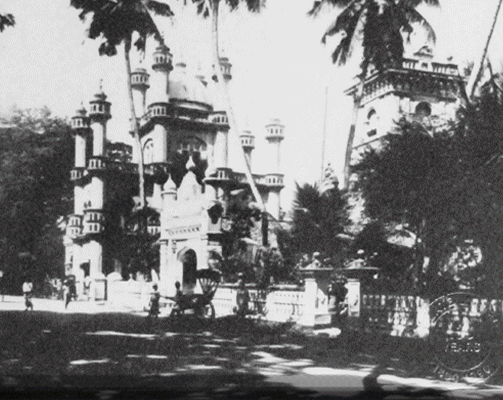
Very little can be said about the art and architecture of the Muslims of Sri Lanka. As they were not a ruling race but a commercial community in constant mobility and movement there did not exist a conducive environment for the development and flourishing of any elaborated refined art forms. Generally in the history of Islamic buildings Mosques occupy a central place. Bur we are unable to form an idea about the architectural features of the early mosques erected by the Muslims during the pre-Portuguese period, as most of them were destroyed by the Portuguese. Generally speaking we may assume that Muslim settlements would have centered around the Mosques that normally forms the nucleus of all religious activities. Judging from the present Mosques, which are erected on traditional pattern one mat, identify the essential features of the Sri Lankan Mosque architecture. Mosques appeared to have been simple structures where the faithful gathered for prayer and also for social inter course. The Mosques did not have elaborate decorative work, floral designing, calligraphic ornamentations which are the general features of traditional Mosque architecture. Mihrab formed and important feature of Sri Lankan Mosques and sometimes one could observe ornamental floral decorative work in the Mihrab in some Mosques. But calligraphic ornamentations is totally absent. Minmber is another essential feature of Sri Lankan Mosques. The most noteworthy feature is the absence of Dorm and Minaret in Sri Lankan traditional Mosque architecture. But these features are added in the new Mosques that are being constructed. The Mosques in Sri Lanka have their unique architectural style and individuality as seen in Maradana, Puttalam, and Kandy Meera Makam Mosques.
Generally speaking Folklore reflects the beliefs, customs and traditions, rituals and ceremonies associated with the community of people. Folksongs form an important segment of Folklore. Muslims of the Eastern province of Sri Lanka has a very rich tradition of Folksongs. These songs are sung by the ordinary Folk on various occasions such as birth, marriage, fishing, harvesting and other important social events. But this has become a fastly vanishing tradition. Thanks to the efforts of the department of Muslim Religious and Cultural Affairs under the Ministry of Religious and Cultural Affairs a serious effort was made recently to collect these Folksongs and document them.
In conclusion I must say that Sri Lanka’s Islamic heritage is a crucible in which cultural elements from diverse sources such as Middle East, Indian Subcontinent were moulded into tradition which eventually resulted in a cultural pattern with its marked distinction, identity and individuality in short. It is a tapestry in which threads of many colours are woven ultimately displaying a sense of unity and a texture that adds lustre and light, beauty and elegance to the workmanship of the multifarious races, nations and cultures which really contributed to the formation of Sri Lanka’s Islamic cultural heritage.
Sri Lanka’s Islamic cultural heritage is a standing testimony to the tolerance, magnanimity and generosity of the majority community in the midst of which Muslims were able to exist, practice their religion, promote their culture as an independent entity, preserving their cultural identity for over a millennium.
REFERENCES:
- Mahavamsa, ed. W. Geiger, London, P.T.S., 1950, ch.10, v.90
- Al-Baladuri, Futuhul Buldan, Cairo, 1935, p. 423
- Martha Pricket, Excavations at Mantai, 1980, Preliminary Report of the Field Director.
- Imam, S.A, “Ceylon Arab Relations”, MICH First Twenty Five Years Souvenir, Colombo, 1965,
- Sir Alexander Johnston, Footnotes to his Dispatch to the Secretary of State dated 3rd February 1827, Transactions of RAS (GB & Ireland) vol.1, p. 537
- Imam, S.A, cit, p. 175
- Imam, S.A, “Cultural Relations Between Sri Lanka and Iran”, in Sri Lanka and the Silk Road of the Sea, Colombo, 1990, p.176
- Nicholas, C.W, and Paranawithana, S, A Concise History of Ceylon, Colombo, 1961, P.163
- Paranawithana, S, God of Adam’s Peak, Switzerland, 1957
- Nafis, Ahmed, “The Arabs Knowledge of Ceylon”, Islamic Culture, Hydrabad, 1940, p.221
- Codrington, H.W, A Sinhalese Embassy to Egypt, JRAS (Ceylon Branch), XXVIII, No. 72. pp 82-85
- Codrington, H.W, Ceylon Coins and Currency, Colombo, 1924, pp.158-159
- Silva, K.M.D, A History of Sri Lanka, Delhi, 1961, p.91
- Anwer, G, Chejne, The Arabic Language, its Role in History, Minneapolis, 1967, p.87
- Seyed Muhammad Al-Naquib Al Attas, Islam and Secularism, Kuala Lumpur, 1978, p.168
- Trimingham, Spencer, J, The Influence of Islam in Africa, London, 1930, p.30
- Trimingham, cit, p.31
- Azeez, A.M.A, Kilakkapirika Karchikal, (Tamil), Colombo, p. 153
- Shukri, M.A.M., Muslims of Sri Lanka (edited), Colombo, 1986, pp.347-348
- Seyed Muhammad Al-Naquib Al Attas, cit, p.162
- Rihla ibn Batuta (Arabic), Cairo Edition, 1948, pp. 109-110
- Shukri, M.A.M., cit, pp. 352-353
- Lorna Dewaraja, The Muslims of Sri Lanka – One Thousand Years of Ethnic Harmony (900 – 1915), Colombo, 1994, p.128
- Imam, S.A, “Ceylon Arab Relations”, ibid. p.
- Lorna Dewaraja, cit. p. 128